BRITISH COLUMBIA · IMPLEMENTATION PREPARATION
BC Restricted Insurance Licensing: Prepare the Customer Journey Before 2027
Before rewriting an insurance offer, map who sells it, who answers the customer and which date applies. A clear website should support the business’s actual authority.
The verified position: one regulation, different transition situations
This is preparation coverage, not an announcement made today. BC’s Restricted Insurance Agent Licence Regulation takes effect January 1, 2027. It concerns specified non-insurance businesses selling specified insurance incidentally to their main business; it is not a general permission to sell every insurance product. The December 18, 2025 Order in Council provides the regulation and its business/product pairings.
The Insurance Council’s implementation overview, checked October 26, distinguishes new sellers from those using previous exemptions. New sellers covered by the regime need the licence from January 1, 2027. Previously exempt incidental sellers must apply by March 31, 2027 to continue selling; current restricted-travel licence holders have until December 31, 2027 to transition. Confirm the applicable category directly rather than treating March 31 as everyone’s start date.
The Council’s licensing preparation page still describes a proposed program undergoing rule-making and anticipates applications after January 1. Proposed qualifications include E&O insurance, an authorized-insurer contract and a designated representative. Do not describe an application process as open or a proposed detail as final without rechecking.
IAM analysis · communications and operations
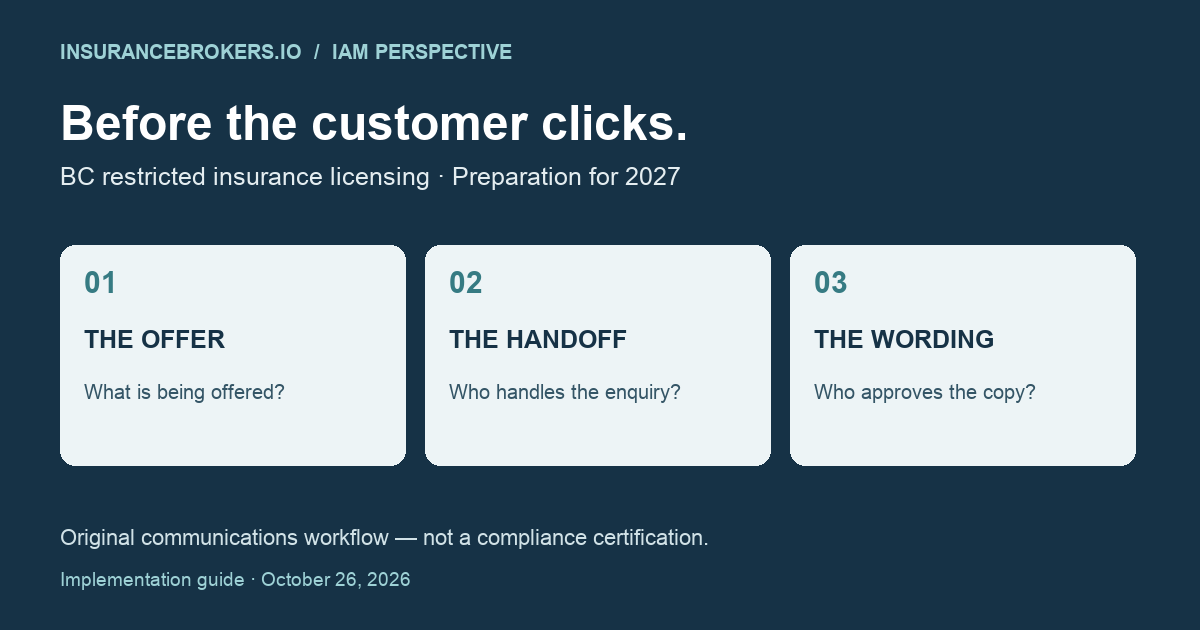
Start with the offer, rather than the homepage headline
Our recommended first step is a small inventory of every place insurance appears: product pages, checkout screens, staff scripts, downloadable brochures, confirmation messages and advertisements. Beside each one, record the product being discussed, the business named and the person responsible for checking the wording.
This exercise makes an otherwise broad website project manageable. A generic button such as “Get protected” can hide several different actions. Does it request information, send a customer to another provider, or begin a sale? Write the intended action in plain language before designing the button. A design review should expose uncertainty so the appropriate insurance or regulatory professional can answer it.
Make the handoff visible
A visitor should be able to understand which business they are contacting. For each form, examine the on-screen description, destination and confirmation message together. If the business only passes an enquiry to another party, describe that actual handoff. Avoid implying that submitting a form has purchased insurance or confirmed coverage.
Use a test enquiry containing no sensitive customer information to check routing with the responsible team. A working link proves only that a link opens. Delivery and the reply process need their own evidence. Keep confidential transactions out of public project screenshots and marketing case studies.
Separate regulatory review from brand approval
A marketing team can make wording understandable, but clarity alone does not establish that a business may offer a product. Assign the authority question to a suitably qualified reviewer, then let the design and content teams work from the approved scope. Retain the version reviewed, the reviewer’s decision and the date.
A practical approval record can be short: page or script, proposed change, open question, responsible reviewer, decision and next review date. If an answer remains pending, keep it visibly pending in the internal record. Do not turn a draft website badge into an assertion of licensing.
Prepare reusable content without publishing future claims
Build reusable fields for business identity, contact routes and source-check dates. Draft alternative wording for the different actions your website genuinely supports. Keep future-state copy out of production until its owner has confirmed it. That lets the team prepare efficiently without quietly representing a future arrangement as a current service.
Schedule a fresh source review before changing public claims. When official implementation material changes, compare the affected passages with the approval record rather than replacing whole pages from memory. Preserve useful history internally while giving visitors the current, accurately dated explanation.
Questions for the next working meeting
- Which business/product pairing needs a determination from the Council or a qualified adviser?
- Which website actions are information requests, referrals or actual sales steps?
- Who owns the source check and who may approve public wording?
- What evidence will show that an enquiry reached its intended recipient?
- Which proposed or future details must stay out of live advertising?
These are original IAM workflow suggestions, not additional regulatory requirements. The applicable licence conditions, insurer arrangements and policy wording determine the insurance position. This article does not interpret a particular policy or promise coverage, lower premiums or liability protection. IAM provides marketing analysis and does not act as a licensed insurance broker through this article.
Related reading and the right next step
For a separate BC brokerage requirement, read the mortgage brokerage E&O document guide. Property managers can use the strata winter responsibilities checklist to organise a different operational conversation.
Ask Industry Army Marketing about clearer content, branding and enquiry journeys. Insurance licensing questions belong with the Insurance Council; policy questions belong with your insurer or licensed insurance professional.
Contact IAM about marketing ↗Primary sources and date check
- BC Order in Council 598/2025 and attached regulation — approved December 18, 2025; effective January 1, 2027.
- Insurance Council of BC: RIA overview — transition guidance checked October 26, 2026; no page publication date asserted.
- Insurance Council of BC: Get Licensed — proposed program details checked October 26, 2026; implementation remains subject to current official guidance.
Regulatory facts are attributed above. Sections labelled IAM analysis are original editorial recommendations, not a statement of regulatory approval.