CANADA · RESPONSIBLE AI · IAM BUSINESS ANALYSIS
AI-Assisted Insurance Content Needs a Named Reviewer
A fluent draft is not the same as an approved insurance explanation. Give every public page a clear purpose, a supported source and a person responsible for the version customers actually read.
The source context: responsible AI, published October 15
On October 15, 2026, OSFI endorsed the FSB’s responsible-AI sound practices. Its statement highlights accountability, human oversight, data governance and controls proportionate to each use case. OSFI describes the practices alongside its existing financial-institution guidelines. This is the dated context for today’s analysis, not a new announcement on October 28, 2026.
The FSB final report contains 12 practices addressing organizational governance and AI lifecycle management. The original report says the practices are non-prescriptive and do not constitute a binding international standard. It encourages a proportionate approach for financial institutions. These publications do not establish a new blanket website rule for every Canadian insurance brokerage. Applicable obligations still depend on the business, jurisdiction and activity.
IAM analysis · proposed editorial workflow
Choose the customer question before the drafting tool
For an insurance business, a useful page might explain what information to prepare for a broker conversation or how to contact the right team. That purpose is different from deciding whether a particular loss is covered. Write the intended reader question at the top of the private brief so the draft does not quietly expand into advice it was never meant to provide.
Define the region and subject as well. A general Canadian explanation should not acquire a province-specific assertion just because a drafting tool supplies a confident example. If the content depends on a product, insurer or wording, the responsible insurance professional needs to determine which current material can support it.

Keep a small source record with the draft
Our suggested editorial record contains the source URL, publisher, relevant date and the specific statement the source supports. Distinguish the date an announcement happened from the date your article was published. An older useful resource can support a practical lesson without being presented as breaking news.
Use approved public or otherwise authorized source material. A public website draft does not need private client claim files or identifying customer records to be useful. Keep confidential information in the business’s approved systems and have the responsible team decide what may be used. A source link gives a reviewer somewhere to check; it does not automatically validate every sentence around it.
Make review a task, not a reassuring label
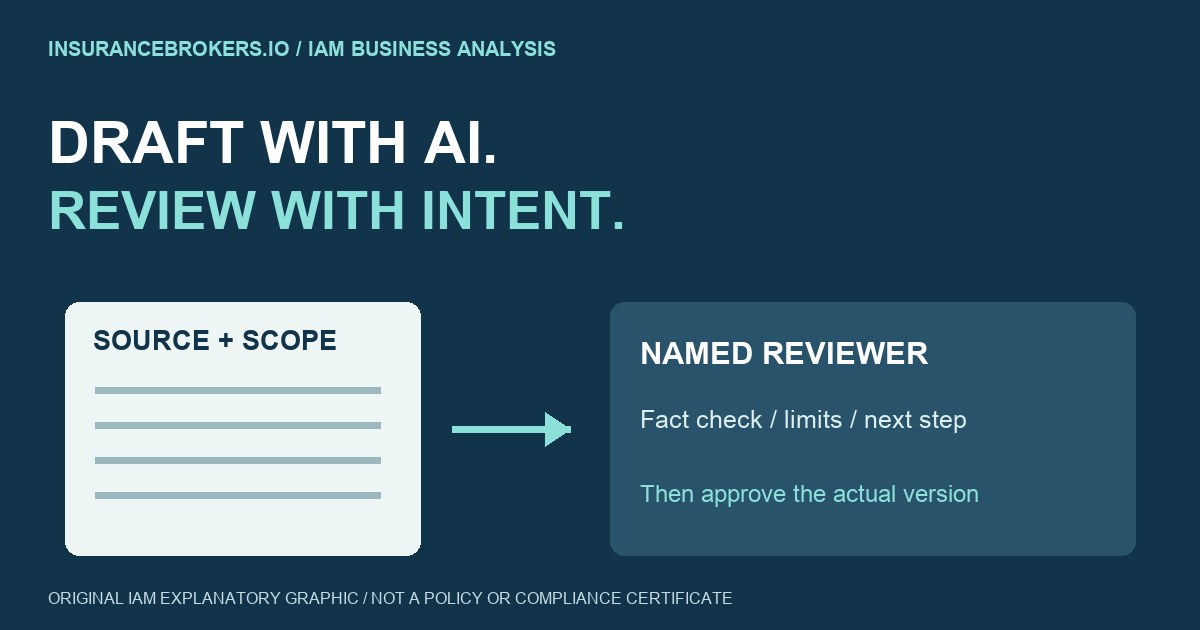
“Human reviewed” is vague unless someone has checked the actual version. In our proposed workflow, a named reviewer checks factual statements, the intended jurisdiction, unsupported assumptions and the destination of the call to action. The business chooses an appropriately qualified person for any regulated or policy-specific content. An agency editor can improve clarity without becoming an insurance adviser.
For example, an illustrative draft might turn “ask about available options” into “your business is protected.” A reviewer should identify that change in meaning and return it for correction. This is an editorial example, not an assessment of a real policy. Do not treat a disclaimer at the bottom as a repair for an unsupported promise in the heading.

Separate explanation from an insurance decision
A useful call to action tells the reader what happens next: contact the brokerage, prepare the requested information or discuss a question with the appropriate licensed professional. It should not suggest that reading an article, receiving an automated acknowledgement or submitting an enquiry confirms insurance coverage, a price or acceptance of a claim.
If an AI feature is involved, describe only what it actually does and what has been tested. A draft generator, a search aid and a tool that responds directly to customers have different interactions to review. This article does not evaluate a live AI insurance product or claim that IAM supplies regulated advice. IAM’s contribution here is marketing and communications analysis.
Keep the approved version connected to its review
Store the approved text with its source record, review date and responsible owner. When a source changes or a product description is replaced, the team can identify which public pages need another look. A recurring review date is a useful prompt; it is not evidence that a review happened.
Check the customer journey as well as the prose. Does the contact link reach the intended business? Is the regional context visible on a phone? Can the reader distinguish sourced facts from commentary? If a correction is needed, record what changed and why without resetting an old publication date to make the article look new.

A modest next step for the business
Choose one existing public page and review it against a short brief: purpose, source, region, wording, enquiry owner and next review. Record the actual result and any correction. This is a practical IAM suggestion inspired by the governance discussion, not a substitute for the firm’s legal, regulatory or professional review.
For a separate operational issue, see our shared-vendor business-continuity guide. For BC licensing implementation preparation, see the restricted-insurance website-readiness guide. Those articles answer different questions; none determines a customer’s coverage.
Discuss branding, website messaging and publishing workflows with IAM. Take policy, coverage and regulated-practice questions to the appropriate licensed professional.
Discuss marketing communications ↗Sources, dates and limits
- OSFI statement on responsible-AI sound practices — October 15, 2026; Canadian financial-institution context.
- FSB final-report publication page — October 15, 2026; international financial-institution practices.
- FSB original final report, PDF — October 15, 2026; non-prescriptive scope and proportionality.